MYCSS

Показ дописів із міткою datascience. Показати всі дописи

2024-11-08

Using Apache Spark with Python, emphasizing its role compared to Celery

🚀 Python у розподілених обчисленнях: Apache Spark проти Celery

Ви коли-небудь замислювалися, чи може Apache Spark впоратися з розподіленими завданнями в Python, як Celery? Давайте розберемо відмінності і те, коли варто використовувати кожен з них.


Apache Spark з Python (PySpark)

🔹 Spark - це потужний фреймворк для великомасштабної обробки даних. За допомогою PySpark ви можете обробляти величезні набори даних і виконувати такі завдання, як ETL (Extract, Transform, Load або Витяг, Перетворення та Завантаження), аналіз даних і машинне навчання між кластерами.
🔹 Spark є відмовостійким та оптимізованим для пакетної обробки розподілених наборів даних, що робить його ідеальним рішенням для роботи з великими даними.


Celery для робочих процесів на основі завдань

🔹 Celery, з іншого боку, призначена для планування завдань та асинхронної обробки. Часто в парі з веб-додатками вона ідеально підходить для таких завдань, як надсилання сповіщень або запуск фонових завдань.
🔹 На відміну від Spark, Celery краще підходить для виконання індивідуальних завдань у режимі реального часу, а не для масштабної обробки даних.


Основні висновки

⭐ Використовуйте Spark для обробки великих даних, ETL та конвеєрів машинного навчання.
⭐ Використовуйте Celery для управління окремими завданнями, особливо у веб-додатках.

2024-07-23

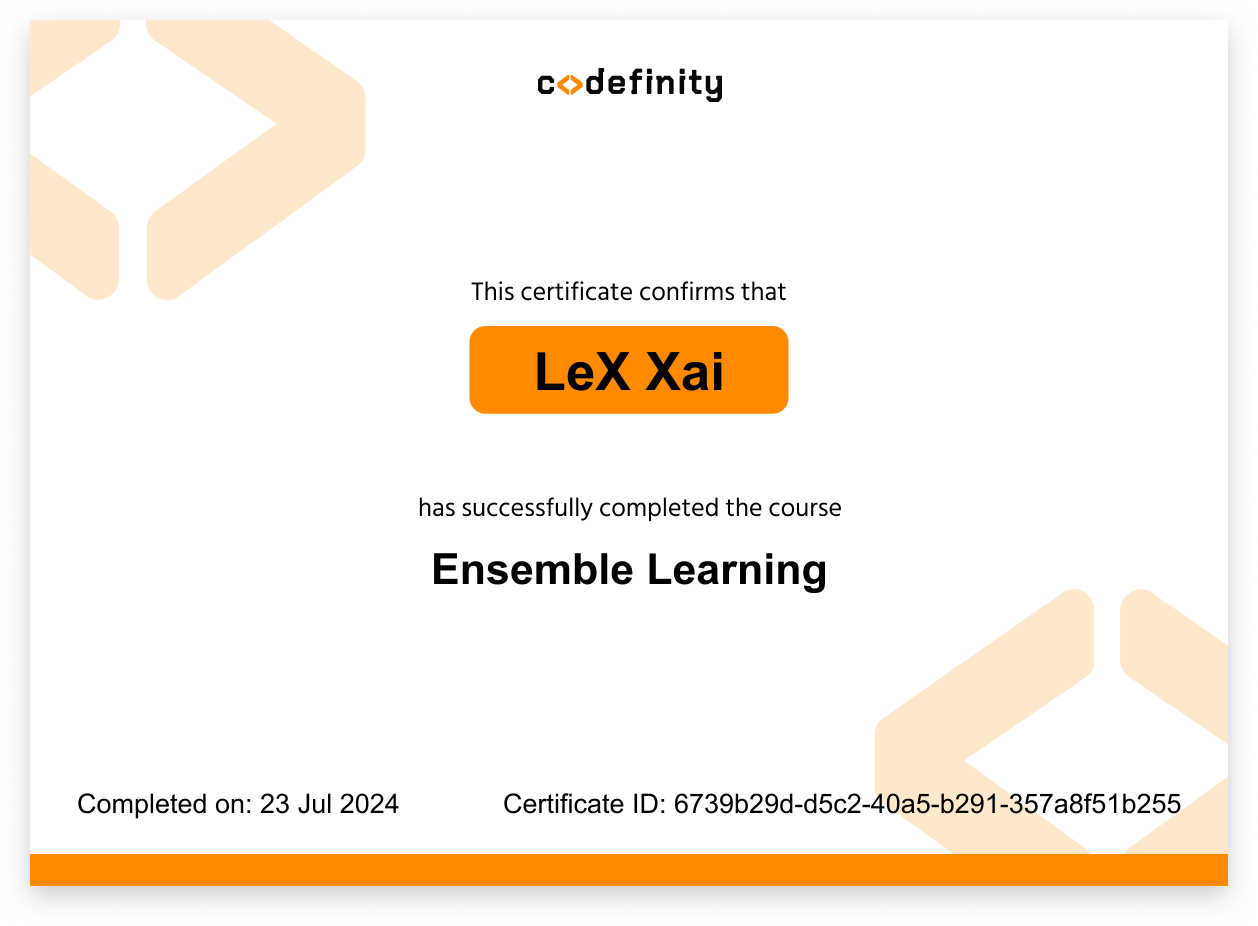
Codefinity. Course Ensemble Learning

Ensemble Learning is an advanced machine learning technique that combines multiple models to improve overall predictive performance and decision-making when solving real-life tasks. 

Author: Ruslan Shudra

Let's summarize and highlight the main information covered in the course.

Ensemble learning in machine learning is a technique that combines the predictions of multiple individual models (learners) to produce a more robust and accurate prediction or classification. It leverages the principle that by aggregating the opinions of multiple models, you can often achieve better results than relying on a single model.
There are three commonly used techniques for creating ensembles: bagging, boosting, and stacking.

Ensemble Learning


2024-07-21

Codefinity. Course Cluster Analysis.

Course Classification with Python of track Foundations of Machine Learning.

Clustering is one of the fundamental machine learning techniques that allows you to solve many complex problems in real life: market segmentation, anomaly detection, dimensionality reduction, revealing hidden patterns, etc.

Author: Ruslan Shudra

Cluster Analysis


2024-07-08

Codefinity. ML Introduction with scikit-learn.

Course. ML Introduction with scikit-learn of track Foundations of Machine Learning.

Machine Learning is now used everywhere. Want to learn it yourself? 

This course is an introduction to the world of Machine learning for you to learn basic concepts, work with Scikit-learn – the most popular library for ML and build your first Machine Learning project. 

This course is intended for students with a basic knowledge of Python, Pandas, and NumPy.

Author: Volodymyr Romanovych


ML Introduction with scikit-learn.

2024-05-01

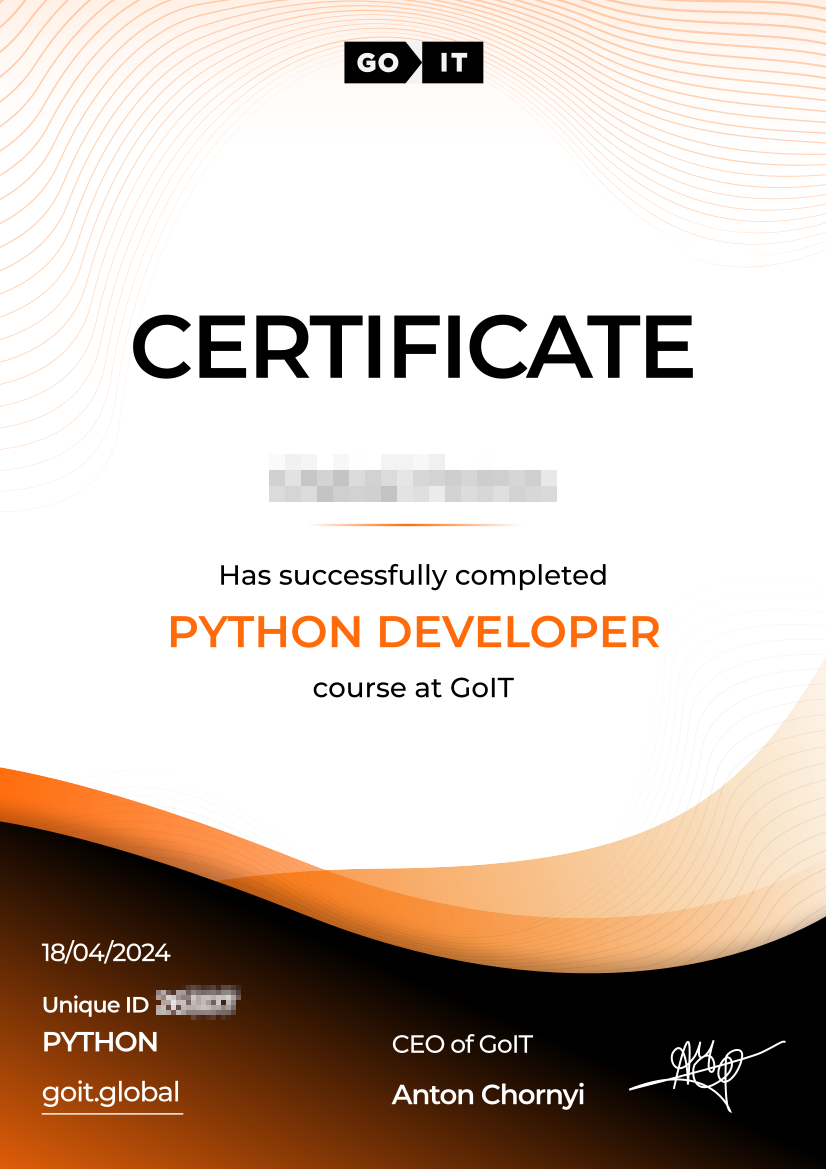
Certificate from IT academy GoIT - Python developer

Минув рік дуже інтенсивного навчання в IT академії GoIT - тепер я Python Developer.

Моїм напрямком було вивчення мови програмування #Python з застосуванням у вебзастосунках та у галузі Data Science і машинного навчання (ML).

 Отримав сертифікат Python Developer.

Сертифікат Python Developer.


2024-04-26

Mодуль "Python Data Science" в IT академії GoIT - проєкт на тему "Автоматизована система паркування".

💡 Закінчили навчання за останнім третім модулем "Python Data Science" в IT академії GoIT - start your career in IT.
🚩 Було створено команду 🇺🇦 розробників - "Neuron Curve Bobr".
🚗 В результаті командної роботи був виконанний груповий проєкт на тему "Автоматизована система паркування".

Дякую 🔥 команді за нашу спільну роботу впродовж напружених 🔨 двох тижнів.


Курсовий проєкт на тему "Автоматизована система паркування".

Згідно з технічним завданням на проєкт: Система автоматично може визначати номери автомобільних знаків на зображеннях з використанням методів машинного навчання.

Функції застосунку:

  • Управління обліковими записами користувачів
  • Візуалізація про кількість вільних та зайнятих паркомісць.
  • Приймання зображень від користувача (симуляція роботи відеокамери)
  • Виявлення та виділення області з номерним знаком
  • Детекція номерного знаку
  • Розпізнавання символів для ідентифікації тексту номерного знаку
  • Перевірка номера авто у базі зареєстрованих транспортних засобів
  • Запис часу в'їзду/виїзду кожного разу, коли визначається номерний знак
  • Відстеження тривалості паркування
  • Розрахунок загальної тривалості паркування
  • Зберігання даних про тривалість паркування в базі даних;
  • Розрахунок вартості паркування. Керування тарифами. Чек за QR-кодом;
  • Генерація звітів про розрахунки, які можна експортувати у форматі CSV
  • Оплата послуги паркування

Проєкт на тему "Автоматизована система паркування".

2024-04-07

Machine Learning Operations (MLOps): Getting Started | Google Cloud Skills Boost

Кроки для здобуття необхідних навичок для спеціальностей з напрямку AI & Data на платформі Google Cloud Skills Boost завдяки можливості надданій Google Ukraine.

Course: Machine Learning Operations (MLOps): Getting Started

Summary

This course introduces participants to MLOps tools and best practices for deploying, evaluating, monitoring and operating production ML systems on Google Cloud. MLOps is a discipline focused on the deployment, testing, monitoring, and automation of ML systems in production. Machine Learning Engineering professionals use tools for continuous improvement and evaluation of deployed models. They work with (or can be) Data Scientists, who develop models, to enable velocity and rigor in deploying the best performing models.


Machine Learning Operations (MLOps): Getting Started, 07.04.2024

2024-04-04

Implement Load Balancing on Compute Engine Skill Badge | Google Cloud Skills Boost | Credly

Кроки для для здобуття необхідних навичок для спеціальностей з напрямку AI & Data на платформі Google Cloud Skills Boost завдяки можливості надданій Google Ukraine.

Course: Implement Load Balancing on Compute Engine

Summary

Complete the Implement Load Balancing on Compute Engine skill badge to demonstrate skills in the following: write gcloud commands and use Cloud Shell, create and deploy virtual machines in Compute Engine, run containerized applications on Google Kubernetes Engine, and configure network and HTTP load balancers.

Implement Load Balancing on Compute Engine Skill Badge, 04.04.2024


Recommendation Systems on Google Cloud | Google Cloud Skills Boost

Кроки для для здобуття необхідних навичок для спеціальностей з напрямку AI & Data на платформі Google Cloud Skills Boost завдяки можливості надданій Google Ukraine.

Курс: Recommendation Systems on Google Cloud

Recommendation Systems on Google Cloud, Apr 3, 2024

Summary

In this course, you apply your knowledge of classification models and embeddings to build a ML pipeline that functions as a recommendation engine. This is the fifth and final course of the Advanced Machine Learning on Google Cloud series.

  • Recommendation Systems Overview
  • Content-Based Recommendation Systems
  • Collaborative Filtering Recommendations Systems
  • Neural Networks for Recommendation Systems 
  • Reinforcement Learning

2024-03-28

Natural Language Processing on Google Cloud | Google Cloud Skills Boost

Кроки для для здобуття необхідних навичок для спеціальностей з напрямку AI & Data на платформі Google Cloud Skills Boost завдяки можливості надданій Google Ukraine.

Курс: Natural Language Processing on Google Cloud


Natural Language Processing on Google Cloud, Mar 26, 2024

Summary

This course introduces the products and solutions to solve NLP problems on Google Cloud. Additionally, it explores the processes, techniques, and tools to develop an NLP project with neural networks by using Vertex AI and TensorFlow.

  1. NLP on Google Cloud
  2. NLP with Vertex AI
  3. Text representatation
  4. NLP models

2024-03-26

Computer Vision Fundamentals on Google Cloud | Google Cloud Skills Boost

Кроки для для здобуття необхідних навичок для спеціальностей з напрямку AI & Data на платформі Google Cloud Skills Boost завдяки можливості надданій Google Ukraine.

Курс: Computer Vision Fundamentals on Google Cloud

Computer Vision Fundamentals on Google Cloud,  Mar 25, 2024

Summary

This course describes different types of computer vision use cases and then highlights different machine learning strategies for solving these use cases. The strategies vary from experimenting with pre-built ML models through pre-built ML APIs and AutoML Vision to building custom image classifiers using linear models, deep neural network (DNN) models or convolutional neural network (CNN) models.

The course shows how to improve a model's accuracy with augmentation, feature extraction, and fine-tuning hyperparameters while trying to avoid overfitting the data.

The course also looks at practical issues that arise, for example, when one doesn't have enough data and how to incorporate the latest research findings into different models.

Learners will get hands-on practice building and optimizing their own image classification models on a variety of public datasets in the labs they will work on.

  • Module 1: Introduction to Computer Vision and Pre-built ML Models with Vision API
  • Module 2: Vertex AI and AutoML Vision on Vertex AI
  • Module 3: Custom Training with Linear, Neural Network and Deep Neural Network model
  • Module 4: Convolutional Neural Networks
  • Module 5: Dealing with Image Data

2024-03-24

Production Machine Learning Systems | Google Cloud Skills Boost

Кроки для для здобуття необхідних навичок для спеціальностей з напрямку AI & Data на платформі Google Cloud Skills Boost завдяки можливості надданій Google Ukraine.

Курс: Production Machine Learning Systems

Production Machine Learning Systems, Mar 23, 2024

Summary

This course covers how to implement the various flavors of production ML systems— static, dynamic, and continuous training; static and dynamic inference; and batch and online processing. You delve into TensorFlow abstraction levels, the various options for doing distributed training, and how to write distributed training models with custom estimators.

This is the second course of the Advanced Machine Learning on Google Cloud series. After completing this course, enroll in the Image Understanding with TensorFlow on Google Cloud course.

  • Module 1: Architecting Production ML Systems
  • Module 2: Designing Adaptable ML Systems
  • Module 3: Designing High-performance ML Systems
  • Module 4: Hybrid ML Systems

2024-03-20

Machine Learning in the Enterprise | Google Cloud Skills Boost

Кроки для для здобуття необхідних навичок для спеціальностей з напрямку AI & Data на платформі Google Cloud Skills Boost завдяки можливості надданій Google Ukraine.

Курс: Machine Learning in the Enterprise

Machine Learning in the Enterprise - Mar 20, 2024

Summary

This course encompasses a real-world practical approach to the ML Workow: a case study approach that presents an ML team faced with several ML business requirements and use cases. This team must understand the tools required for data management and governance and consider the best approach for data preprocessing: from providing an overview of Dataow and Dataprep to using BigQuery for preprocessing tasks.

The team is presented with three options to build machine learning models for two specic use cases. This course explains why the team would use AutoML, BigQuery ML, or custom training to achieve their objectives. A deeper dive into custom training is presented in this course. We describe custom training requirements from training code structure, storage, and loading large datasets to expoing a trained model.

You will build a custom training machine learning model, which allows you to build a container image with lile knowledge of Docker.

The case study team examines hyperparameter tuning using Veex Vizier and how it can be used to improve model peormance. To understand more about model improvement, we dive into a bit of theory: we discuss regularization, dealing with sparsity, and many other essential concepts and principles. We end with an overview of prediction and model monitoring and how Veex AI can be used to manage ML models

● Module 1: Understanding the ML Enterprise Workow
● Module 2: Data in the Enterprise
● Module 3: Science of Machine Learning and Custom Training
● Module 4: Veex Vizier Hyperparameter Tuning
● Module 5: Prediction and Model Monitoring Using Veex AI
● Module 6: Veex AI Pipelines
● Module 7: Best Practices for ML Developmen

2024-03-10

Feature Engineering | Google Cloud Skills Boost

Кроки для для здобуття необхідних навичок для спеціальностей з напрямку AI & Data на платформі Google Cloud Skills Boost завдяки можливості надданій Google Ukraine.

Курс: Feature Engineering

Feature Engineering - Mar 9, 2024
Summary

Want to know about Veex AI Feature Store? Want to know how you can improve the
accuracy of your ML models? What about how to nd which data columns make the most
useful features? Welcome to Feature Engineering, where we discuss good versus bad
features and how you can preprocess and transform them for optimal use in your models.
This course includes content and labs on feature engineering using BigQuery ML, Keras, and
TensorFlow.

2024-03-06

TensorFlow on Google Cloud | Google Cloud Skills Boost

Кроки для для здобуття необхідних навичок для спеціальностей з напрямку AI & Data на платформі Google Cloud Skills Boost завдяки можливості надданій Google Ukraine.

Курс: TensorFlow on Google Cloud

TensorFlow on Google Cloud. Mar 5, 2024

Summary

This course covers designing and building a TensorFlow input data pipeline, building ML models with TensorFlow and Keras, improving the accuracy of ML models, writing ML models for scaled use, and writing specialized ML models.


#MachineLearning #MachineLearningModels #MachineLearningPipeline

BADGES


2024-03-01

Згорткові нейронні мережі (Conv), що таке знайоме :)

Ознайомлюючись з лекцію про "Згорткові нейронні мережі" (Conv) в темі "Python Data Sciense" школи GoIT. Думаю що ж таке знайоме.

convolutional neural network

Знаходжу код далекого 2014 року, де у браузері, в той час Chrome NaCL мав можливість виконувати порогами клієнта на С, компілювавши на стороні клієнта файл (.pexe), писали код котрий покращував зображення відео на "льоту" через OpenGL Shaders.

(Capture кадр відео, і поверх відео малював  OpenGL зображення, а оригінальне відео не було видно.)

Так от там і були операції як раз такі самі як у Conv kernel 3х3 , і середнє потім забиралося. 😀

const char kFragShaderSource[] =  "precision mediump float;\n"
 "uniform sampler2D u_texture;\n"
 "uniform float imgWidth;\n"
 "uniform float imgHeight;\n"
 "varying vec2 v_texcoord;\n"
 "float kernel[9];\n"
 "vec2 offset[9];\n"
 "float step_w = 1.0/imgWidth;\n"
 "float step_h = 1.0/imgHeight;\n"
 "void main() {\n"
 "offset[0] = vec2(-step_w, -step_h);\n"
 "offset[1] = vec2(0.0, -step_h);\n"
 "offset[2] = vec2(step_w, -step_h);\n"
 "offset[3] = vec2(-step_w, 0.0);\n"
 "offset[4] = vec2(0.0, 0.0);\n"
 "offset[5] = vec2(step_w, 0.0);\n"
 "offset[6] = vec2(-step_w, step_h);\n"
 "offset[7] = vec2(0.0, step_h);\n"
 "offset[8] = vec2(step_w, step_h);\n"
 "kernel[0] = 0.;\n"
 "kernel[1] = -.4;\n"
 "kernel[2] = 0.;\n"
 "kernel[3] = -.4;\n"
 "kernel[4] = 2.6;\n"
 "kernel[5] = -.4;\n"
 "kernel[6] = 0.;\n"
 "kernel[7] = -.4;\n"
 "kernel[8] = 0.;\n"
 "vec4 sum = vec4(0.0);\n"
 "int i;\n"
 "for (i = 0; i < 9; i++) {\n"
 "vec4 color = texture2D(u_texture, (vec2(1.0,1.0)-v_texcoord) + offset[i]);\n"
 "sum += color * kernel[i];\n"
 "}\n"
 "gl_FragColor = sum;\n"
 "}\n";

kernel:

 0.0  -0.4   0.0
-0.4   2.6  -0.4
 0.0  -0.4   0.0
Так як паддінгу не було, на жаль в коді.
То по периметру були проблеми на 1 піксель :)
"offset[0] = vec2(-step_w, -step_h);\n"

2024-02-26

Launching into Machine Learning | Google Cloud Skills Boost

Кроки для для здобуття необхідних навичок для спеціальностей з напрямку AI & Data на платформі Google Cloud Skills Boost завдяки можливості надданій Google Ukraine.

Курс: Launching into Machine Learning

Launching into Machine Learning. Feb 26, 2024


Learning Objectives

● Describe how to improve data quality
● Peorm exploratory data analysis
● Build and train AutoML Models using Veex AI
● Build and train AutoML Models using BigQuery ML
● Optimize and evaluate models using loss functions and peormance metrics
● Create repeatable and scalable training, evaluation, and test datasets

Summary

The course begins with a discussion about data: how to improve data quality and peorm
exploratory data analysis. We describe Veex AI AutoML and how to build, train, and deploy
an ML model without writing a single line of code. You will understand the benets of Big
Query ML. We then discuss how to optimize a machine learning model and how
generalization and sampling can help assess the quality of ML models for custom training

#MachineLearning #MachineLearningModels #MachineLearningPipeline

BADGES


2024-02-18

Introduction to AI and Machine Learning on Google Cloud | Google Cloud Skills Boost

Кроки для для здобуття необхідних навичок для спеціальностей з напрямку AI & Data на платформі Google Cloud Skills Boost завдяки можливості надданій Google Ukraine.

Курс: Introduction to AI and Machine Learning on Google Cloud

This course introduces the artificial intelligence (AI) and machine learning (ML) offerings on Google Cloud that support the data-to-AI lifecycle through AI foundations, AI development, and AI solutions. It explores the technologies, products, and tools available to build an ML model, an ML pipeline, and a generative AI project based on the different goals of users, including data scientists, AI developers, and ML engineers.

#MachineLearning #MachineLearningModels #MachineLearningPipeline


Introduction to AI and Machine Learning on Google Cloud | Google Cloud Skills Boost

BADGES

Коли забув ти рідну мову, біднієш духом ти щодня...
When you forgot your native language you would become a poor at spirit every day ...

Д.Білоус / D.Bilous
Рабів до раю не пускають. Будь вільним!

ipv6 ready